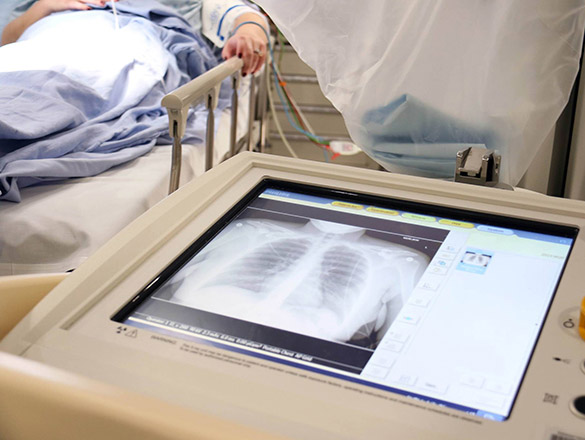
Medical imaging is the branch of medicine that uses radioactive substances, electromagnetic waves, radiation and sound waves to create images of the body, including its organs and structures. Eskenazi Health radiologists use these images to assist with their diagnosis and treatment of diseases or other health problems.
While radiation does have potential side effects, medical experts, including Eskenazi Health radiologists, agree the risks of radiation are outweighed by the information that these images can show about a patient's condition.
Eskenazi Health offers a variety of imaging tests to help diagnose and treat patients. Depending on the type of imaging test being done, patients may be asked for details about:
Medical history, including previous surgeries
Previous imaging tests
Possible pregnancy (some tests can be dangerous for the fetus)
Metal in the body such as implants, pacemakers, surgical clips or any other type of metal
Overview
An echocardiogram, or echo for short, is an ultrasound, which bounces sound waves off the heart to create images that can help physicians detect problems.
Chest Echo (Transthoracic)
A transthoracic echocardiogram (TTE) is taken from the surface of the chest wall with transducer or probe (device that looks like a microphone). It can show:
The functioning of heart valves
Tumors or infectious growths around heart valves
The outer lining of the heart (pericardium)
Problems with the large blood vessels that enter and leave the heart
Blood clots in the heart chambers
Abnormal holes between heart chambers
Transesophageal Echo (TEE)
Transesophageal echocardiography (TEE) records images of the heart with a probe inside the esophagus to help detect and treat problems such as infection, disease, or defects in the heart’s function, walls or valves. This test may be done when a chest echocardiogram (transthoracic) does not provide enough information.
Patients are given a throat spray to numb the throat and may be given medicine through an intravenous line (IV) in the arm to help them relax.
Computed tomography (CT) uses X-rays and computer scans to create a detailed picture that can show problems with soft tissues, such as the lining of sinuses, organs, kidneys, lungs, blood vessels and bones. CT can be used to assist in guidance for biopsies and invasive procedures.
Eskenazi Health uses two 256-slice CT scanner for cardiac imaging and a 128-slice scanner for invasive imaging.
Fluoroscopy procedures are performed at the Sidney & Lois Eskenazi Hospital on the downtown campus and can be scheduled Monday through Friday.
Magnetic resonance imaging (MRI) uses strong magnets and radio waves to capture an image of the inside of the body. Eskenazi Health has two 1.5 Tesla MRI machines.
Metal objects cannot be near an MRI machine. Patients will be asked to change into hospital provided scrubs, and asked to remove jewelry, belts and any other item that contains metal. Be sure to tell the technologist if you have any form of metal in your body. Metal can be found in many items, including, but not limited to:
Ear (cochlear) implants
Clips used for brain aneurysms
Metal coils put in blood vessels
Defibrillators
Pacemakers
Artificial joints
Adhesive patches
Splinters
Make-up
Magnetic eyelashes
Some forms of athletic clothing
A mammogram is an X-ray image of the breast that is used for screening and to detect problems such as cysts or cancer. Having a regular mammogram is the best step women can take to detect breast cancer early. Eskenazi Health offers the latest 2D and 3D breast imaging, as well as automated breast ultrasound for patients with dense breast tissue.
For more information about Eskenazi Health’s breast services, please visit the St. Margaret's Hospital Guild Diagnostic Breast Center page.
Using a special camera and a small amount of radioactive material, a nuclear medicine scan captures images of organs (heart, lungs, liver and gallbladder) and bones. Nuclear medicine scans may be used to both diagnose and treat disease. Some types of common nuclear medicine scans include:
-
Bone scans
-
Cardiac stress tests
-
Thyroid imaging with therapeutic services
-
SPECT (single photon emission computed tomography)
Eskenazi Health offers general ultrasound, OB ultrasound and vascular ultrasound, as well as ultrasound elastography, which identifies the elasticity and stiffness of soft tissue. Ultrasound can be used to assist in guidance for biopsies and invasive procedures.
Ultrasound uses sound waves to capture images of internal organs. It can be used to detect organ problems, such as gallstones, kidney stones or liver disease. It can also show the details of many blood vessels in the abdomen and be used to evaluate blood flow in the abdomen.
Ultrasound does not use ionizing radiation and does not have any known risks.
An X-ray machine uses a small amount of radiation to create images of bones and internal organs. X-rays are most often used to detect bone or joint injuries or changes or to check the heart and lungs. X-rays can be taken at the Sidney & Lois Eskenazi Hospital on the downtown campus, Eskenazi Health Center West 38th Street and Eskenazi Health Thomas & Arlene Grande Campus. X-rays do not require an appointment.
Location Service Hours
-
Hours
Mammography and Ultrasound
Sunday Closed Monday 7:30 a.m. - 5 p.m. Tuesday 7:30 a.m. - 5 p.m. Wednesday 7:30 a.m. - 5 p.m. Thursday 7:30 a.m. - 5 p.m. Friday 7:30 a.m. - 5 p.m. Saturday Closed X-Ray
Sunday Closed Monday 7:30 a.m. - 5:30 p.m. Tuesday 7:30 a.m. - 5:30 p.m. Wednesday 7:30 a.m. - 5:30 p.m. Thursday 7:30 a.m. - 5:30 p.m. Friday 7:30 a.m. - 5:30 p.m. Saturday Closed
Price Transparency – Radiology Services
-
Hours
CT Scan, Mammography, MRI, Ultrasound and X-Ray
Sunday Closed Monday 7:30 a.m. - 7:30 p.m. Tuesday 7:30 a.m. - 7:30 p.m. Wednesday 7:30 a.m. - 7:30 p.m. Thursday 7:30 a.m. - 5:30 p.m. Friday 7:30 a.m. - 5:30 p.m. Saturday Closed
Price Transparency – Radiology Services
-
Hours
X-Ray
Sunday 7:30 a.m. - 6 p.m. Monday 7 a.m. - 8 p.m. Tuesday 7 a.m. - 8 p.m. Wednesday 7 a.m. - 8 p.m. Thursday 7 a.m. - 8 p.m. Friday 7 a.m. - 8 p.m. Saturday 7:30 a.m. - 6 p.m. MRI and CT
Sunday 8 a.m. - 5 p.m. Monday 7 a.m. - 8 p.m. Tuesday 7 a.m. - 8 p.m. Wednesday 7 a.m. - 8 p.m. Thursday 7 a.m. - 8 p.m. Friday 7 a.m. - 8 p.m. Saturday 8 a.m. - 5 p.m. PET/CT and Nuclear Medicine
Sunday Closed Monday 7:30 a.m. - 3:30 p.m. Tuesday 7:30 a.m. - 3:30 p.m. Wednesday 7:30 a.m. - 3:30 p.m. Thursday 7:30 a.m. - 3:30 p.m. Friday 7:30 a.m. - 3:30 p.m. Saturday Closed Cardiac Diagnostics
Sunday Closed Monday 7 a.m. - 5 p.m. Tuesday 7 a.m. - 5 p.m. Wednesday 7 a.m. - 5 p.m. Thursday 7 a.m. - 5 p.m. Friday 7 a.m. - 5 p.m. Saturday Closed Ultrasound
Sunday 8 a.m. - 5 p.m. Monday 7 a.m. - 8 p.m. Tuesday 7 a.m. - 8 p.m. Wednesday 7 a.m. - 8 p.m. Thursday 7 a.m. - 8 p.m. Friday 7 a.m. - 8 p.m. Saturday 8 a.m. - 5 p.m.
-
Hours
Sunday Closed Monday 7:30 a.m. - 4 p.m. Tuesday 7:30 a.m. - 6 p.m. Wednesday 7:30 a.m. - 6 p.m. Thursday 7:30 a.m. - 4 p.m. Friday 7:30 a.m. - 4 p.m. Saturday Closed