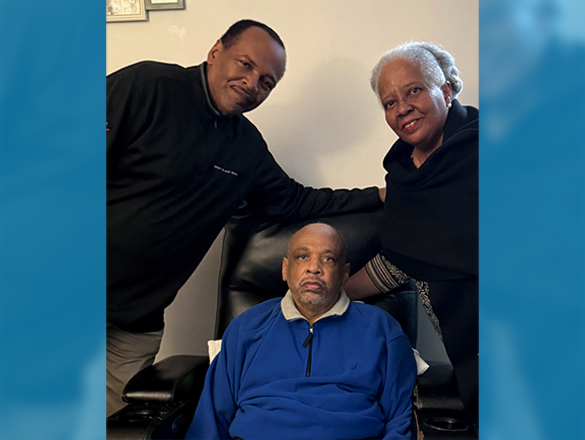
“Your responsibility is to each other,” Cheryl Westmoreland, M.D., remembers her mother repeating to her and her siblings.
“Family first,” adds her younger brother, Michael Westmoreland.
But when their oldest sibling, Walter, experienced a massive stroke in 2016, the two knew they’d struggle to support a brother as stubborn as theirs.
“Walter wasn’t the easiest in the family,” Dr. Cheryl Westmoreland laughs, recalling his rebellious youth. The free-spirited oldest Westmoreland child had grown into a man who savored his autonomy. When his first stroke was followed by mobility struggles, increasing dementia and additional strokes, he had “difficulty with accepting his limitations,” his sister says.
The Westmoreland siblings and their mother wanted to do everything they could to assist their fiercely independent loved one with aging in place. They were unprepared, however, for what that goal would entail — especially before working with their health team at Eskenazi Health Senior Care.
Already in her 80s, their mom took the lead, rallying like she “had her Ph.D. in social work,” says Dr. Cheryl Westmoreland. This included preparing meals, arranging family check-ins and managing transportation to medical appointments. When Michael Westmoreland took over as primary family caregiver, however, his brother resisted. His sister explains that her younger brother had transitioned from “no authority in Walter’s world” to owning his dwelling and managing his activities.
Walter Westmoreland also sometimes mistook his siblings for strangers and ordered them to leave his home when they visited to assist him. The two were soon managing professional home care teams and scrambling with shifting insurance requirements. By the time they made their first appointment with Eskenazi Health Senior Care, Dr. Cheryl Westmoreland says they were “overwhelmed” and “losing the battle” to keep their brother in his home.
Eskenazi Health Senior Care provides an interdisciplinary team approach. When Dr. Cheryl and Michael Westmoreland met geriatric specialist Olivia Nirmalasari, M.D., and social worker Emily Taylor, MSW, they were stunned by the amount of assistance being offered. Michael Westmoreland says his first reaction was, “Is this just heaven?”
This degree of care, says Dr. Cheryl Westmoreland, takes a team “committed towards helping families on a very basic level.”
Right away, his new medical team familiarized themselves with Walter Westmoreland’s personality and medical history. They insisted that his professional home care teams check his blood pressure multiple times daily. His siblings, who had worried about his hypertension since his first stroke, finally felt they could comfortably “go to work every day” says Dr. Cheryl Westmoreland.
She describes Dr. Nirmalasari as “the sweetest, kindest … the most enlightening person” and “the most intelligent geriatrician I have ever worked with in my career.”
“And then you have Emily [Taylor],” says Michael Westmoreland. “She’s the type of person that’s very responsive. If we need something, need a letter, need to know something ….”
“She facilitates,” says his sister.
Both siblings recall Taylor expertly handling the complexities of their insurance battles. As Michael Westmoreland puts it, “No problem was difficult to answer for Emily.”
As their brother’s dementia progressed, 24-hour care and education for the family about sundowning became critical. Without his care team’s help, Michael Westmoreland says, “we could have never done it.”
Whether expediting medications or records or documenting why Walter Westmoreland’s care hours are a medical necessity, his health team members, says Dr. Cheryl Westmoreland, “fight for his life on a daily basis.”
Both siblings have observed signs of their brother’s improved wellbeing since he began working with Eskenazi Health Senior Care. Dr. Cheryl Westmoreland says his blood pressure is better than it’s ever been. They’re both delighted to witness their brother singing again, something they thought he’d given up.
Most of all, they enjoy observing their sibling’s interactions with his care team. “We see how everybody treats our brother. It’s just unbelievable,” says Michael Westmoreland. “I’m just waiting for the first mean person.”
“They identify strategies that are going to work for my brother … strategies that we can be an integral part of ….” Dr. Cheryl Westmoreland says. “There was life before Emily and Dr. Olivia, and there was life after …. I think that says it all ….”
In addition to their Eskenazi Health Senior Care team, the Westmorelands have access to the services of the Aging Brain Care program, which functions under the Sandra Eskenazi Center for Brain Care Innovation at Eskenazi Health. The program offers funding for respite services and access to a care coordinator assistant trained in dementia care to help coach and educate families. For more on that program and the Westmorelands’ experiences with it, view the video featuring them on the Aging Brain Care page of the Eskenazi Health website.